
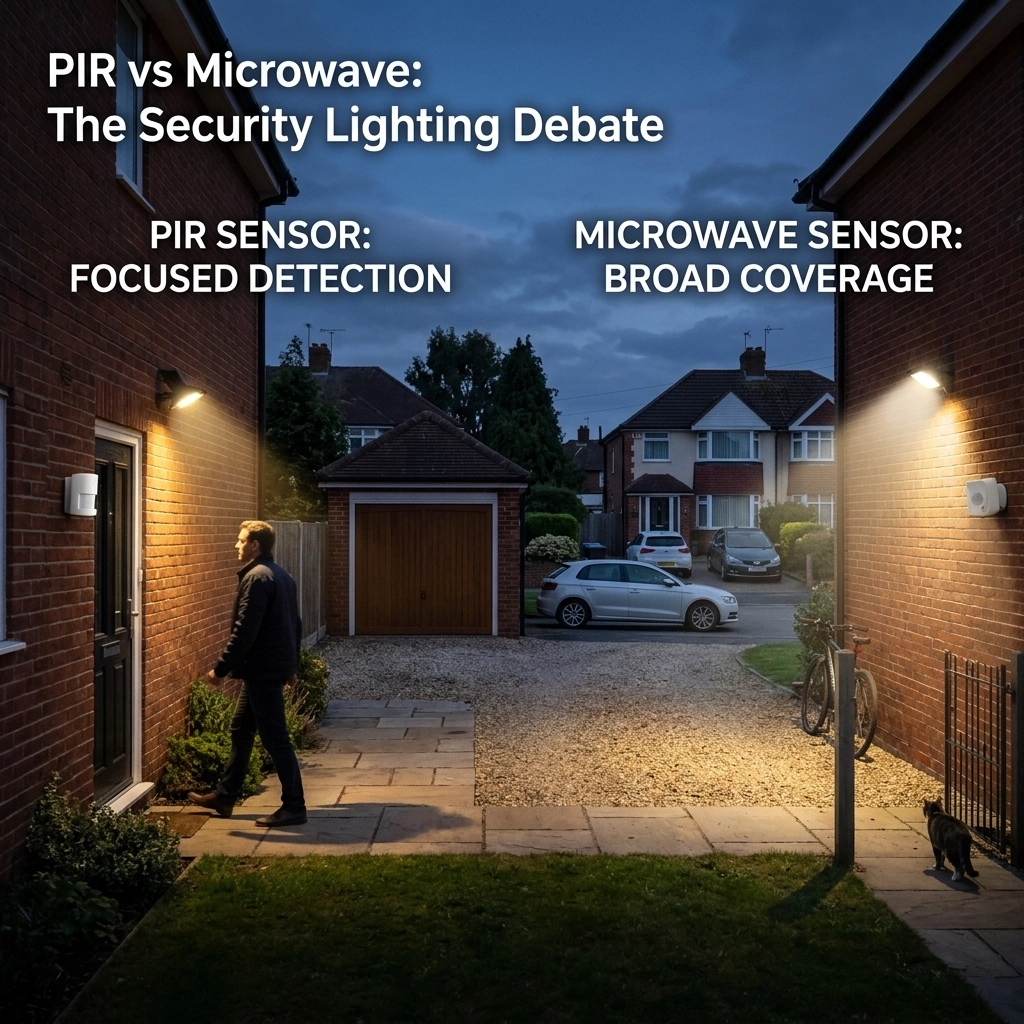
When you’re walking up your driveway after a long day, there’s nothing quite as welcoming as your security lights flicking on to guide you to the door. But beyond the convenience, those lights are a vital part of your Home security systems. They aren't just there to stop you from tripping over the cat; they are there to tell potential intruders that they’ve been spotted.
The big question we get asked here at i-Spy CCTV is: "Which sensor should I use?"
Not all motion sensors are created equal. In the world of security lighting, two main technologies battle it out: PIR (Passive Infrared) and Microwave. Choosing the wrong one could mean your lights are constantly blinking at passing cars, or worse, staying dark when someone is actually on your property. As your southwest security experts, we’re here to break down the tech so you can enjoy total peace of mind.
Understanding the Science of Security
Before we dive into which is "better," we need to look at how these gadgets actually work. It’s not magic: it’s physics: and understanding it will help you create a robust defense for your home.
The Power of Passive Infrared (PIR)
PIR sensors are the most common type of motion detector you’ll find in residential settings. They are "passive" because they don't send anything out; instead, they sit quietly and wait for a change in heat.
Every living thing (and most moving things like cars) emits heat in the form of infrared radiation. A PIR sensor has a thin layer of material that is sensitive to these heat signatures. When a person walks into the sensor's field of vision, the sensor detects a rapid change in infrared energy and triggers the light.
Why homeowners love PIR:
- Reduced False Alarms: Because they focus on heat, they aren't usually triggered by blowing leaves or a stray plastic bag.
- Energy Efficient: They use very little power while they wait.
- Bespoke Coverage: You can often "mask" certain areas of the sensor so it doesn't pick up the neighbour’s garden.

The Range of Microwave Sensors
Microwave sensors are a different beast entirely. Unlike PIR, these are "active" sensors. They send out continuous pulses of microwave radiation (don't worry, it’s completely safe!) and measure the time it takes for those waves to bounce back.
Think of it like a bat using echolocation. If something moves in the area, the timing of the reflected waves changes, and: boom: the lights come on.
The Microwave Advantage:
- 360-Degree Coverage: They generally offer a much wider detection area than PIR.
- Wall-Penetrating: These sensors can "see" through thin walls, glass, and timber.
- High Sensitivity: They can detect even the smallest movements, making them incredibly meticulous at spotting intruders.
The Showdown: PIR vs Microwave
So, which one wins the crown for your property? It really depends on where you live and what you’re trying to protect.
| Feature | PIR Sensors | Microwave Sensors |
|---|---|---|
| Detection Method | Heat signatures (Infrared) | Wave reflection (Motion) |
| Sensitivity | Medium (Good for humans/cars) | High (Detects through walls) |
| False Alarm Risk | Low (Wind/Trees won't trigger) | High (Can be triggered by pipes/wind) |
| Ideal Environment | Small gardens, driveways, halls | Large warehouses, open car parks |
| Weather Impact | Can struggle in extreme heat | Unaffected by temperature |
Why PIR is Usually the King of the Home
For most homeowners in the Southwest, from the quiet streets of Devizes to the bustling suburbs of Windsor, PIR is the clear winner.
Why? Because nobody wants their bedroom light-up like a Christmas tree every time a gust of wind hits the hedge. PIR sensors are reliable, cost-effective, and specifically tuned to detect the heat of a human body. This makes them the perfect first line of defense for a standard driveway or back garden.
When to Consider Microwave Sensors
Microwave sensors are often the go-to choice for our commercial clients. If you have a large warehouse or a business premises in Worcester, the ability to detect motion through partitions or across massive open spans is a huge benefit.
However, for a home, they can be too good. If you install a microwave sensor in your porch, it might detect your own family moving around inside the house through the front door, keeping the lights on all night. That's a quick way to annoy the neighbours and run up your electricity costs.

Enhancing Your System with NVR IP Cameras
Lighting is a fantastic deterrent, but it's only half the story. To achieve unparalleled protection, we always recommend integrating your motion-activated lighting with a high-quality NVR IP camera system.
An NVR (Network Video Recorder) allows your cameras to record high-definition footage that you can access from your phone anywhere in the world. When your PIR sensor detects movement and floods the area with light, your IP cameras get a crystal-clear, full-colour image of exactly who is there.
This seamless integration between lighting and video is what creates a truly robust security setup. Whether you are at home or on holiday, you’ll have the tranquility of knowing your property is looking after itself.
The i-Spy CCTV Expert Approach
At i-Spy CCTV, we don’t just "fit" lights and cameras. We design bespoke security solutions tailored to your specific property. As southwest security experts, we follow a meticulous process to ensure you get the best results:
- Consultation: We visit your property to identify "blind spots" and high-risk areas.
- Design: We choose the right tech: whether that’s PIR for your front door or a hybrid system for a large outbuilding.
- Installation: Our engineers provide a clean, professional install with no messy wires.
- Training: We show you exactly how to use your new system, including how to adjust sensor sensitivity on your phone.
We pride ourselves on providing a professional, authoritative, and reassuring service. We want you to feel empowered by your security, not confused by it.

Nearby Areas We Cover
We are proud to serve homeowners and businesses across the South West. If you’re looking for expert advice or a professional installation, we’ve got you covered in:
- Bristol & Bath: Protecting city homes and rural retreats.
- Gloucester & Cheltenham: Specialized systems for Regency properties and modern builds.
- Newport & Cardiff: Comprehensive security for our Welsh neighbours.
- Swindon & Reading: Keeping the M4 corridor safe and sound.
- Exeter & Weston-super-Mare: Coastal security solutions that last.
- Oxford & Banbury: Sophisticated tech for historic locations.
Whether you're in Ross-on-Wye or Tiverton, our team is ready to help you secure your property.
Take the First Step to a Safer Home
Choosing between PIR and Microwave sensors is just the start. Every property has its own unique quirks, and what works for a semi-detached in Redditch might not be right for a manor house in Midhurst.
Don't leave your safety to chance. i-Spy CCTV is here to ensure your home remains a serene environment for you and your family. We offer a cutting-edge approach to security that puts your needs first.
Ready to upgrade your home security?
We invite you to book a free security survey with one of our experts. We’ll walk your property with you, identify any weaknesses, and provide a no-obligation quote for a system that gives you real peace of mind.
Contact i-Spy CCTV today: your local southwest security experts.

Categories/Tags: Bristol, Cardiff, Gloucester, Banbury, Basingstoke, Bath, Bournemouth, Bracknell, Bridgend, Cheltenham, Chippenham, Cirencester, Cwmbran, Dorchester, Malmesbury, Newbury, Newport, Oxford, Poole, Reading, Slough, Southampton, Stratford upon Avon, Swansea, Winchester, Worcester, Yeovil, Swindon, Taunton.