
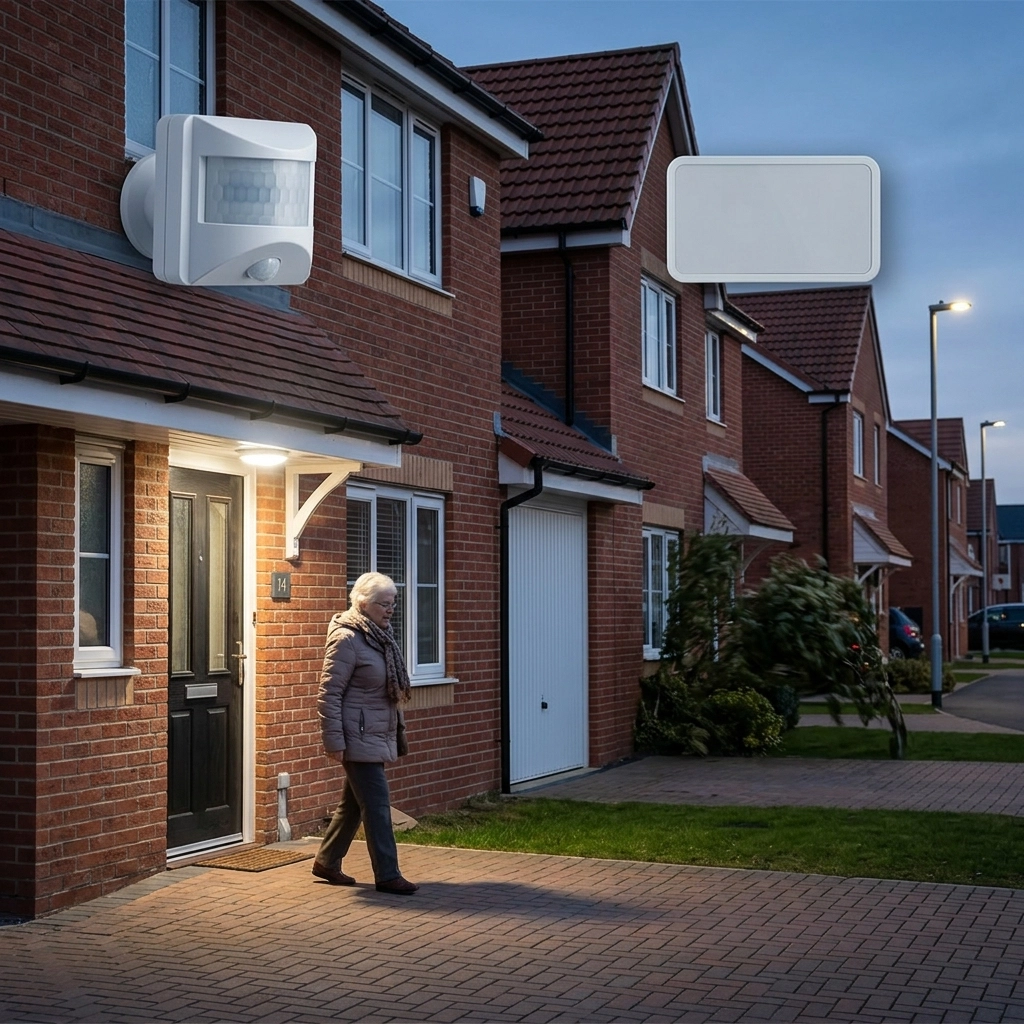
When you’re tucked up in bed on a rainy Tuesday night in the South West, the last thing you want to worry about is what that noise was in the garden. We’ve all been there, peering through the curtains, wondering if it’s just a stray cat or something more sinister. This is where security lighting steps in, acting as your first line of defense and providing that much-needed peace of mind.
But here’s the kicker: not all security lights are created equal. The "brain" behind the light, the sensor, is what determines whether your driveway illuminates for a potential intruder or stays dark while a fox trots past. At i-Spy CCTV, we often get asked by homeowners from Bristol to Reading about the tech inside their systems. Specifically, the battle between PIR (Passive Infrared) and Microwave sensors.
Choosing the right one can be the difference between a seamless, robust security setup and a frustrating light that flashes every time the wind blows. Let’s dive into the nuts and bolts of both to see which one deserves a spot on your property.
Understanding PIR Sensors: The Heat Seekers
PIR stands for Passive Infrared. These are the most common sensors you’ll find in residential settings across the UK. But how do they actually work?
Instead of "seeing" movement like a camera does, a PIR sensor looks for changes in heat. It’s essentially a "heat seeker." It monitors the infrared radiation in its field of view. When a person (or a large animal) walks past, their body heat creates a sudden change in infrared energy, which trips the sensor and turns on the light.
The Benefits of PIR for Your Home
- Minimal False Alarms: Because PIR sensors are looking for heat signatures, they aren't easily fooled by a swaying branch or a piece of litter blowing across your lawn. This makes them incredibly reliable for front gardens.
- Cost-Effective: PIR technology is well-established and generally more affordable to install. If you're looking for a high-value, bespoke security solution without breaking the bank, PIR is a fantastic choice.
- Energy Efficiency: These sensors use very little power (usually around 0.8W to 1.0W) because they are "passive", they don't emit anything; they just sit and wait to detect heat.
- Targeted Detection: They require a direct "line of sight." This means they won't be triggered by someone walking around inside your house or a car driving past behind a fence.

Understanding Microwave Sensors: The Radar Experts
If PIR sensors are heat seekers, Microwave sensors are more like radar systems. They work by sending out high-frequency radio waves (microwaves) and measuring the reflection off moving objects. This is known as the Doppler effect.
When these waves hit a moving object, the frequency of the reflected wave changes, which tells the sensor that something is moving. Unlike PIR, these are "active" sensors, meaning they are constantly sending out signals to map the environment.
The Benefits of Microwave Sensors
- Wall-Penetrating Power: One of the most cutting-edge features of microwave sensors is their ability to "see" through thin walls, glass, and doors. This makes them ideal for hidden installations where you want the tech to remain discreet.
- 360-Degree Coverage: While PIR sensors usually have a limited "cone" of vision, microwave sensors often provide full 360-degree coverage, making them perfect for large open areas or complex building layouts.
- Temperature Stability: PIR sensors can struggle in extreme heat (when the ambient temperature is close to body temperature). Microwave sensors don't care about heat; they only care about movement, making them highly reliable in varying weather conditions.
- Longer Range: Generally, microwave sensors can detect movement from much further away than standard PIR units, providing an earlier warning of approaching visitors.

The Head-to-Head: PIR vs. Microwave
To help you decide which is best for your property in Swindon or Oxford, let’s look at how they stack up in the categories that matter most to homeowners.
| Feature | PIR Sensors | Microwave Sensors |
|---|---|---|
| Detection Method | Body heat (Infrared) | Radio wave reflections (Radar) |
| Best For | Driveways, porches, small gardens | Large warehouses, hidden installs, windy areas |
| Through Walls? | No, requires line of sight | Yes, can see through thin barriers |
| False Alarms | Low (ignores inanimate movement) | Higher (can be triggered by pipes or fans) |
| Energy Use | Very Low | Moderate |
| Cost | More Budget-Friendly | Slightly Higher Investment |
Which One Should You Choose?
For the majority of residential homes in the South West, PIR sensors are usually the winner. Their ability to ignore inanimate movement while accurately detecting human heat signatures makes them the meticulous choice for typical domestic entryways. If you are looking for a reliable CCTV and alarm system in Exmouth, a PIR-integrated lighting system offers fantastic protection.
However, if you have a large commercial property or a home with a very complex layout: perhaps where the sensor needs to be hidden behind a decorative panel: then the microwave sensor becomes the robust, cutting-edge solution you need.
Integrating Sensors with NVR IP Camera Systems
At i-Spy CCTV, we believe that security is at its best when it’s integrated. Simply having a light turn on is great, but having that light trigger a high-definition recording on your NVR IP camera system is even better.
When a PIR or microwave sensor detects movement, it can send a signal to your cameras to start recording in high-detail mode or even send a push notification to your smartphone. This ensures that you aren't just scaring off an intruder, but you’re also capturing the evidence you need for total peace of mind. Whether we are doing an intruder alarm installation in Windsor or setting up cameras in Gloucester, we ensure the sensors and cameras work in perfect harmony.

Professional Installation: The i-Spy Difference
You might be tempted to grab a cheap "plug-and-play" sensor from a DIY store, but security is one area where professional expertise pays off. A poorly placed sensor is either useless (because it doesn't catch the intruder) or annoying (because it goes off every time a leaf twitches).
Our team at i-Spy CCTV provides a meticulous, bespoke service. We don't just "fit" lights; we design a security perimeter. We consider:
- Optimal Height: Placing sensors high enough to avoid tampering but low enough to catch movement accurately.
- Angle of Detection: Ensuring the "blind spots" are eliminated.
- Cross-Talk Prevention: Making sure multiple sensors don't interfere with each other.
- Local Conditions: We know the South West. We know the coastal winds in Bournemouth and the leafy suburbs of Cheltenham, and we calibrate your equipment accordingly.
For those in the Midlands area, our Worcester's leading CCTV alarm installers can help you navigate these choices to find the perfect fit for your specific property.
Nearby Areas We Cover
We take pride in being a local business serving a wide range of communities. If you are looking for expert security advice, we cover:
- Bristol & Bath: Local experts for city-centre and suburban homes.
- Wiltshire: From expert security systems in Devizes to professional setups in Chippenham and Salisbury.
- Gloucestershire: Reliable protection in Gloucester, Cheltenham, and Cirencester.
- Oxfordshire: High-end security solutions in Oxford, Abingdon, and Banbury.
- Berkshire & Hampshire: Serving Reading, Slough, Basingstoke, and Southampton.
- Wales: Trusted CCTV and burglar alarms in Pontypool, Newport, and Cardiff.
Final Thoughts: Peace of Mind Starts with the Right Tech
Choosing between PIR and microwave sensors doesn't have to be a headache. It’s all about matching the technology to your specific environment. A PIR sensor offers simplicity and reliability for most homes, while microwave technology provides that extra level of "see-through" detection for more complex requirements.
Whatever you choose, the goal is a serene environment where you feel safe and protected. At i-Spy CCTV, we are committed to providing seamless installation and long-term support to ensure your home remains a sanctuary.
Ready to upgrade your home security? Don't leave it to chance.
We offer a Free Security Survey to help you identify the best sensor types and placements for your property. Our experts will walk through your site, identify vulnerabilities, and provide a bespoke plan for unparalleled protection.